OFFICIAL OPENING IN 2026


Aménopé Togo Permaculture Organisation
Taking Care of Humans with Permaculture

It all started in 2020 with a seed of hope and a good dose of passion!
The name "Aménopé" literally means "where man can live," home, family, in Ewe, a language of Togo.
Here, it's more than just a farm: it's a living ecosystem focused on food and energy self-sufficiency, all orchestrated with the magical principles of Permaculture. And we don't do this alone: we work hand in hand with the environment, the village, and the farmers of Agou-Nyogbo.
🌿 A true sustainable symphony in the heart of Togo!
Yaovi GALEY - Président-Fondateur d'Aménopé
Association Aménopé Togo
Récépissé n° 0568/MATDCL/SG/DLPAP/2025


Président : Yaovi GALEY
Trésorier : Komla Edem KLU
Secrétaire : Koulinte M'LADERANA
Living with one's family, close to nature and in harmony with the immediate environment. Caring for the land, plants, people, and animals. Working with nature rather than against it. Fostering the return of biodiversity, regenerating soils, and producing naturally and abundantly.
Teaching young people common-sense farming practices, permaculture, and traditional Togolese arts to contribute sustainably to strengthening rural communities.
Amenope's dream
Our Team
Stéphane WALGER
Yaovi GALEY
Apefa GOMELAN


Stéphane was born in France, he is a designer and trainer in Permaculture. After having resided and worked for more than 15 years in Mauritius (and OI Region) in the field of Management and Training, he decided to become certified for 6 months in Permaculture in France, then, in 2018, he went for the first time to Togo in the Plateaux region.
It’s love at first sight, the environment and climate are fantastic for launching a permaculture project.
In 2020, he found land in Agou Nyogbo in the plateaux region, the Aménopé adventure can begin.
Stéphane works on the design and implementation of the site's permaculture system.
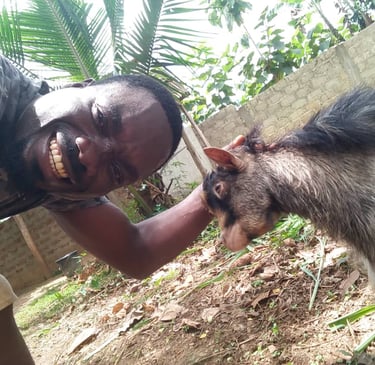
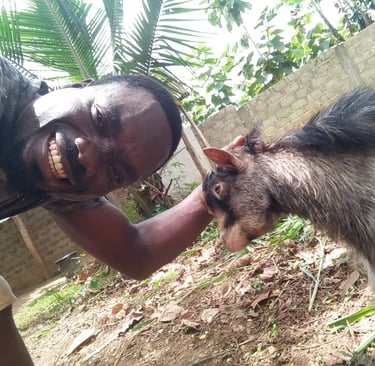
Yao (Yaovi) was born in Togo, he is an artist, musician and wood sculptor. He also runs a craft shop in the center of Kpalimé.
Yao has supported Stéphane since the beginning of the project, from researching the field to facilitating relations with the Agou community and Togolese partners. He ensures the proper functioning of the farm, site management and participates in all activities.
Yao is now a well-respected big brother in the community.
He is the Founding President of the Aménopé Togo Association.
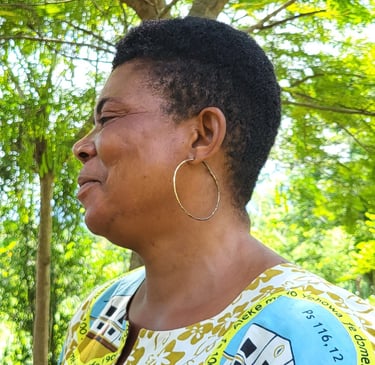
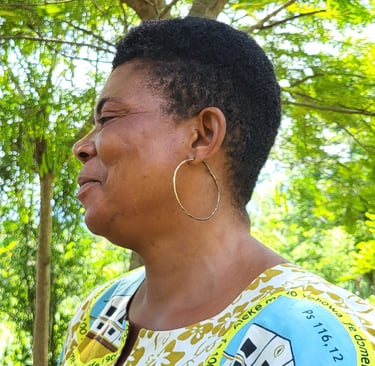
At Amenope, there are faces that we never forget. Among them, that of Apéfa Gomelan, our reception and restaurant manager. Since the very beginning of the Aménopé adventure, she has embodied the human warmth and versatility that make up the soul of the farm.
His ability to juggle these different roles perfectly illustrates what Bill Mollison called a “synergistically living system,” where each element interacts and supports the others.
Through his work, Apéfa demonstrates that permaculture is not only an agricultural method, but also a way of living together, in balance and complementarity.
Permaculture Designer and Founder of Amenope
Founder and President of Amenope
Reception and Restaurant Manager
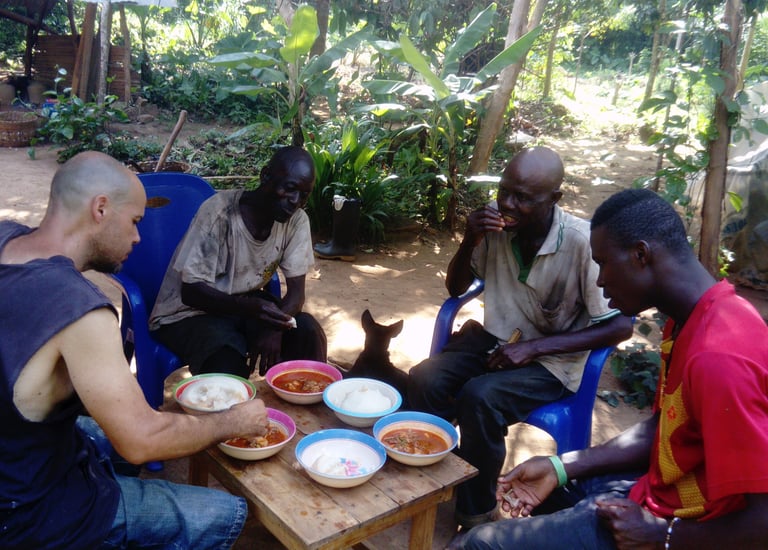
Since the launch of Ferme Aménopé in 2020, we have worked mainly with the community of the canton of Agou and with professionals from the town of Kpalimé for the construction of wells, buildings for animals, huts and houses.
Local young people also come during school holidays to help us clear the site.
We are also very close to the Chief of the Canton of Agou who advises us and finds answers to our questions.
Aménopé is a community farm, the community of the canton of Agou therefore plays an essential role in the success of our project.
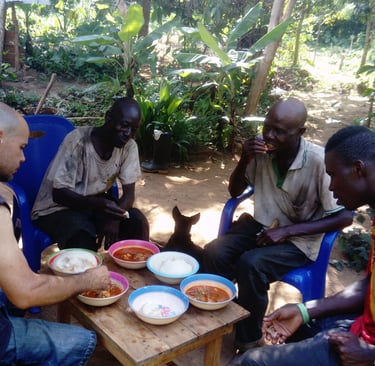
The community of the Agou region
"Go to the people. Live with them. Learn from them. Love them. Start with what they know. Plan with them. Build on what they have. Teach by showing. Learn by doing. Don't conform, but transform. Don't relieve, but liberate. And when with the best leaders, the work is done, the task accomplished, people will say 'we did it ourselves.'
Lao Tseu
2020: The year where everything begins… or almost
Imagine yourself in the middle of the COVID pandemic, the world in “zombie apocalypse” mode, and us, like agricultural ninjas, visiting the site three times a week. We dodge the cops like in an action movie, and when we get caught, hop, a little discreet ticket to buy social peace. Our beginnings? Wild clearing, some annual crops… and theft. Yes, thieves also like oranges and small equipment. Apparently, we had unintentionally launched an underground organic fruit market.
At the end of 2020, COVID rules calm down. I settle in on the farm, in hardcore camper mode in a tent, waiting for the renovation of the mud house. We build a repaired well, a homemade shower, a makeshift kitchen and even a toilet. The first harvests? Lean like a post-holiday diet. Thanks to a Leetchi kitty, we treat ourselves to a new well, just to wage war against the dry season in style. 500 trees planted, all watered by hand, like bodybuilders hydrating their muscles.
2021: The farm goes into “super saiyan” mode
Finally, I'm squatting in the mud house, and we're installing a solar panel, because progress is sexy. With local clay, we make bricks and build everything: chick house, store, tool shed. Even benches and tables for outdoor chilling. The vegetable garden is taking shape, the toilets are becoming glamorous, and two straw huts are being set up to accommodate tents.
Plantations are exploding: banana trees, fruit trees, and even teak (because we like shade AND business). The harvests are still so-so, but we persevere. 400 m² of vegetable garden designed for the wheelbarrow – because even nature loves a good design. And presto, another 500 trees planted. Our arms? Watering machines.
2022: The agricultural level-up
We are redesigning the major crop areas with corn, cassava and pigeon peas. In the vegetable garden? Tomatoes, zucchini, beans, and competition herbs. The henhouse and the store are adorned with roofs and windows. The foundations of the sheepfold are emerging, like a teaser for an agricultural blockbuster.
Youth Green Nature arrives, we plant around a hundred nutrient trees, and Hello Asso crowdfunding begins. Objective ? Capture rainwater. Because, let's be honest, even the rain has to contribute.
2023: Welcome to the “animal farm”
The sheepfold is finished with clay bricks, a tin roof and all modern comforts for the goats. Result ? Our first kid was born on December 14, we named him Bévuvi (little bandit). A star is born. The hard enclosure of the henhouse is almost finished.
2024: We close and we dream bigger
The henhouse becomes a fortress with two mesh doors and a solar panel on the roof. We plant fruit trees for the chickens (because they also deserve organic) and dig “pantry” holes for them. The rotating pasture is born with straw hut and water trough. Composts are rebuilt to transform waste into black gold. We start breeding with goliath chicks.
2025: The grand opening
We are finishing toilets worthy of a five-star hotel (ok, three stars). A restaurant hut is emerging to welcome gourmets, and the first houses for students and customers are under construction. Result ? The Aménopé farm opens its doors to the public, ready to conquer the world, one organic tomato at a time.
To be continued… 🎬
(And who knows, with any luck Hollywood might make a movie about it.)
The Chronicles of Amenope from 2020 to today
Find us
We are located in Agou-Nyogbo Sud, after the Spiruline center and the Agou-Nyogbo high school in the direction of Kpalimé. The town of Kpalimé is 15km from the farm.
Adress
Quartier SOSSI, Agou-Nyogbo Sud
Schedules
09h - 17h
We welcome volunteers from around the world to guide their journeys towards autonomy through learning permaculture.
CONTACT / RESERVATIONS
FOLLOW US ON NETWORKS
amenope.togo@gmail.com
Tel : +228 92 67 00 00
Association Aménopé Togo - Récépissé n° 0568/MATDCL/SG/DLPAP/2025 - All rights reserved. © 2025.


Aménopé Togo
Ferme Aménopé Togo
Quartier SOSSI
Agou-Nyogbo Sud
Kloto, Togo
😎 You have already been to Ferme Aménopé You planted a cutting, shared a meal, followed a course or simply took a deep breath of fresh air in the heart of our forest garden
DONATE 🤍
By supporting Amenope, you become part of a global movement for land regeneration and the dignity of people. Each donation is a seed sown for a fairer, greener and more autonomous future.